
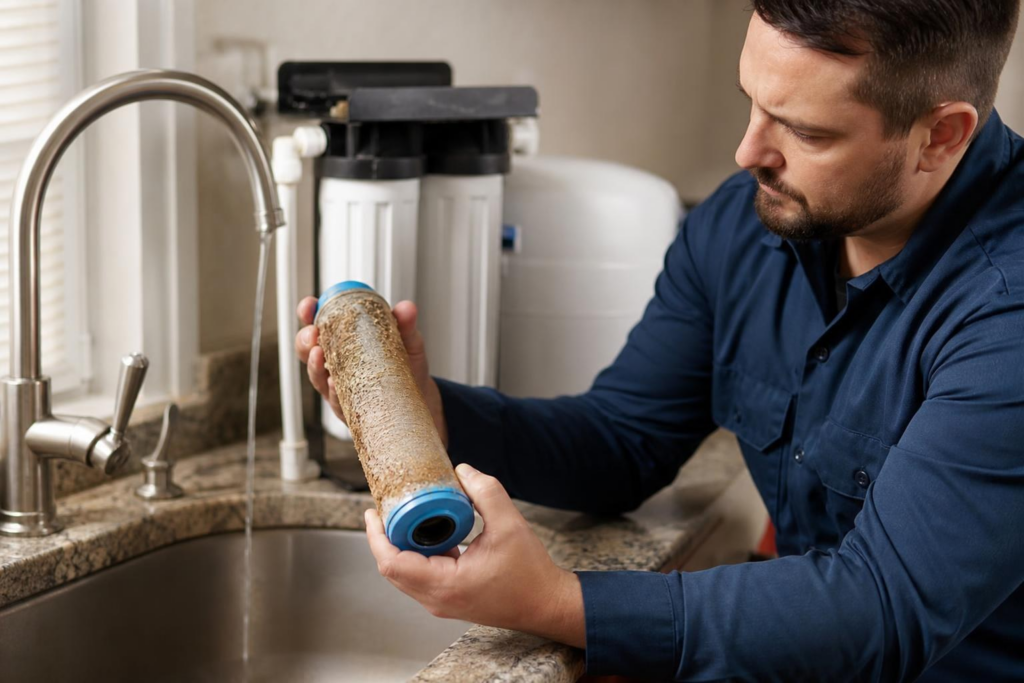
Whitehouse Station sits at the heart of Hunterdon County, where the geology of central New Jersey directly shapes what flows from residential taps. The region’s bedrock, rich in limestone and dolomite, contributes elevated levels of calcium and magnesium to groundwater supplies. For homeowners relying on private wells or even municipal connections in Readington Township, these mineral concentrations create persistent water quality challenges that affect everything from skin health to appliance performance. Understanding the specific conditions that drive hard water problems in this area is the first step toward choosing the right testing and treatment approach for your household.
Understanding the Whitehouse Station Water Landscape
Central Jersey’s water supply draws from a mix of aquifers and surface sources shaped by millions of years of geological activity. The Piedmont Province, which underlies much of Hunterdon County, contains sedimentary rock formations that naturally dissolve calcium, magnesium, and trace minerals into groundwater. Whitehouse Station homeowners who depend on private wells are particularly exposed to these conditions, since their water bypasses municipal treatment processes.
The New Jersey Department of Environmental Protection classifies Hunterdon County as an area with moderate to high groundwater hardness, with readings frequently exceeding 120 milligrams per liter (mg/L) of calcium carbonate. That threshold places most local water firmly in the “hard” to “very hard” category. Municipal systems serving parts of Readington Township do treat for some contaminants, but hardness reduction is generally not part of standard processing.
Seasonal variation also plays a role. Spring snowmelt and heavy rainfall can shift mineral concentrations, and drought conditions tend to concentrate dissolved solids further. This means water quality in Whitehouse Station is not static; it fluctuates throughout the year, making periodic testing essential rather than optional.
Common Hard Water Indicators in Readington Township Homes
Recognizing hard water does not require a laboratory. The signs tend to accumulate gradually, and many homeowners grow accustomed to them without realizing the underlying cause. A few reliable indicators show up consistently in Readington Township residences.
White, chalky deposits on faucets, showerheads, and glass surfaces are among the most visible symptoms. These mineral scale formations, primarily calcium carbonate, build up wherever water evaporates. Soap that refuses to lather properly is another classic sign: hard water reacts with soap molecules to form an insoluble curd rather than suds, leaving a film on skin and hair.
Laundry offers additional clues. Clothes washed in hard water often feel stiff, look dingy, and wear out faster because mineral deposits become trapped in fabric fibers. Dishes pulled from the dishwasher may show spots or a cloudy haze even after a full wash cycle. If you notice a persistent metallic or mineral taste in your drinking water, that is another strong signal that dissolved solids are elevated beyond comfortable levels.
The Impact of Mineral Buildup on Local Infrastructure
The consequences of untreated hard water extend well beyond cosmetic annoyance. Over months and years, mineral accumulation causes measurable damage to household systems, increasing both repair frequency and operating costs.
Plumbing and Appliance Longevity
Scale deposits narrow pipe interiors, restricting flow and increasing pressure on joints and fittings. In older Whitehouse Station homes with galvanized or copper plumbing, this process accelerates corrosion and can lead to pinhole leaks. Water heaters suffer disproportionately: a layer of mineral scale on heating elements acts as insulation, forcing the unit to work harder and shortening its useful life by several years. The Water Quality Association notes that scale buildup of just 1/16 of an inch on a heating element can reduce efficiency by roughly 12 percent.
Dishwashers, washing machines, and coffee makers all experience similar degradation. Internal valves and seals encounter abrasive mineral particles that accelerate wear, and manufacturers’ warranties sometimes exclude damage attributed to excessively hard water.
Energy Efficiency and Utility Costs
The efficiency penalty from scale is not trivial. A water heater operating with significant mineral buildup consumes substantially more energy to reach the same temperature. For an average household in Hunterdon County, this can translate to an increase of $150 to $300 annually in energy costs, depending on water usage and hardness levels. Reduced flow from scaled pipes also means longer run times for appliances, compounding the waste. Addressing water hardness is therefore not purely a comfort decision; it is a financial one.
Essential Water Testing Protocols for Hunterdon County
Hard Water Testing
Before selecting any treatment system, accurate testing establishes a baseline. We recommend starting with a comprehensive water analysis rather than relying solely on a basic hardness strip. A full panel should measure total hardness (calcium and magnesium), pH, total dissolved solids (TDS), iron, manganese, and bacterial contamination. For homes on private wells, New Jersey law requires testing at the time of property sale, but annual testing is a prudent practice.
Several options exist for hard water testing in the Whitehouse Station area. Certified laboratories such as those accredited through the New Jersey Department of Environmental Protection provide the most reliable results. Homeowners can collect samples themselves following proper protocols: use a clean, lab-provided container, run the cold water tap for two to three minutes before collecting, and deliver the sample within the specified timeframe (typically 24 to 48 hours).
Home test kits available from hardware stores offer a rough estimate of hardness levels, measured in grains per gallon (gpg). While useful for quick checks, these kits lack the precision needed to properly size a treatment system. Professional testing typically costs between $50 and $200 depending on the number of parameters analyzed, and the investment pays for itself by preventing the purchase of an undersized or unnecessary system.
Results should be interpreted against EPA guidelines and New Jersey-specific standards. Water above 7 gpg is considered hard, and readings above 10.5 gpg qualify as very hard. Many Whitehouse Station wells test between 10 and 25 gpg, placing them squarely in the range where treatment delivers noticeable benefits.
Advanced Filtration and Softening Solutions
Once testing confirms the nature and severity of your water issues, the right treatment approach depends on what contaminants are present and how the water will be used throughout your home.
Ion Exchange vs. Salt-Free Systems
Traditional ion exchange water softeners remain the most effective method for removing calcium and magnesium. These systems pass water through a resin bed charged with sodium ions, which swap places with hardness minerals. The result is genuinely softened water that prevents scale, improves soap performance, and protects plumbing.
The tradeoff involves salt: ion exchange systems require periodic replenishment of sodium chloride or potassium chloride, and they discharge brine during regeneration cycles. For households concerned about sodium intake or environmental impact, potassium chloride offers a viable alternative, though it costs more per bag.
Salt-free conditioners, often marketed as “water softeners,” work differently. They do not remove minerals but instead alter their crystalline structure so they are less likely to form scale. These systems require no salt, produce no wastewater, and need minimal maintenance. However, they do not reduce measured hardness, which means soap performance and skin feel may not improve as dramatically. For homes with moderate hardness (under 15 gpg) and primarily concerned about protecting pipes and appliances, a salt-free conditioner can be a reasonable choice.
Reverse Osmosis for Potable Water Quality
For drinking and cooking water, reverse osmosis (RO) systems provide an additional layer of purification. An RO unit forces water through a semipermeable membrane that removes up to 99 percent of dissolved solids, including minerals, nitrates, lead, and certain organic compounds. These point-of-use systems typically install under the kitchen sink and produce purified water through a dedicated faucet.
RO systems do produce wastewater, generally at a ratio of about 3:1 (three gallons of waste per gallon of purified water), though newer models have improved this ratio significantly. Pairing an RO system with a whole-home softener creates a comprehensive approach: the softener handles scale prevention throughout the house while the RO unit delivers high-purity water where it matters most for consumption.
Water Softener Installation
Professional installation of a whole-home softener typically takes half a day and involves connecting the unit to the main water line before it branches to fixtures. Proper sizing is critical: an undersized system regenerates too frequently, wasting salt and water, while an oversized unit may allow bacterial growth in stagnant resin. A qualified installer will calculate the correct size based on your tested hardness level, household water usage, and the number of occupants.
Expect installation costs in the Whitehouse Station area to range from $1,500 to $4,000 for a complete system, including the softener unit, bypass valve, drain connection, and labor. Annual maintenance, primarily salt replenishment and occasional resin cleaning, runs approximately $100 to $200.
Whole-Home Filtration Options
Beyond softening, some Hunterdon County homes benefit from broader filtration. Whole-home systems installed at the point of entry can address sediment, chlorine, volatile organic compounds, and iron, all of which occasionally appear in local water supplies. Carbon-based filtration is effective for taste and odor improvement, while specialty media target specific contaminants like iron or hydrogen sulfide (the “rotten egg” smell some well owners encounter).
A staged approach often works best. A sediment pre-filter captures particulates, followed by a carbon or specialty filter, then a softener. This configuration protects the softener resin from fouling and ensures each component operates within its designed parameters. Whole-home filtration systems range from $800 to $3,500 depending on complexity and the contaminants being targeted.
Maintaining Long-Term Water Purity in Your Home
Installing a treatment system is not a set-and-forget proposition. Regular maintenance ensures consistent performance and protects your investment. We recommend testing your water annually, even after installing filtration or softening equipment, to confirm the system is functioning correctly and to catch any changes in source water quality.
Softener resin beds should be sanitized at least once per year, and the brine tank cleaned to prevent salt bridging, a condition where a hardened crust forms above the water line and prevents proper regeneration. RO membranes typically last two to three years, while pre-filters and post-filters need replacement every six to twelve months. Keep a maintenance log with dates and readings so you can identify trends before they become problems.
For Whitehouse Station homeowners dealing with hard water and related quality concerns, the path forward is straightforward: test first, treat based on results, and maintain your system consistently. The right combination of softening and filtration protects your home, reduces long-term costs, and delivers water you can trust at every tap. If you have not had your water tested recently, contact a certified lab or a local water treatment professional to schedule an analysis. The small upfront cost prevents far larger expenses down the line.